MQ1: Some Concluding Thoughts

After a (far too) long break between posts, it seems we ought to conclude the current question for the time being. We may decide to return to parts of it later, if our interest in the topic is rekindled, particularly to actually produce a ranking of some set of the House Speakers. But for now, I’d just like to close the question with some observations on the role of the Speaker of the House and how it is perceived.

When doing my research, and ploughing through name after unfamiliar name on the list of House Speakers, it occurred to me how little you hear about the position on a daily basis. Every day brings some news about the President’s words and actions; about Senate or House as a whole taking a vote; and even about individual senators, who control some powerful committee. But even in this Congress, with arguably one of the most divisive House Speakers in recent memory, very little is ever said about her in the news. And maybe that’s a good thing.

The Speaker of the House is intended to serve as a (ideally) non-partisan shepherd in the chamber, making sure bills come to the floor, debates are conducted civilly, votes are taken and accurately tallied, and performing other formal and administrative tasks so that the day-to-day activities of the House run smoothly. It is left to the majority and minority leaders to get the members of their parties to vote a certain way. The Speaker should be above the fray, an interested observer who is there to make sure all the i’s are dotted and the t’s are crossed. In that sense, it is good that little is heard from or about the Speaker because he or she shouldn’t really be getting involved in the petty mudslinging that generally rules House debates.

Of course, there are rare exceptions (David mentioned in a few of them in his historical review), and it might be worthwhile to look at those Speakers who are considered “strong” to see what attributes they have in common and what actions they took during their terms that might have given them such influence. For the most part, however, the influence of Speakers appears to be minimal, unless it is hiding in back room meetings and secret deals that the American public are not privy to. But to me it seems more likely that the vast majority of House Speakers have simply lived up to the title and have done their duty as the Constitution requires, and little more.
An Historical Perspective

Evaluating the effectiveness of Speakers requires us to take long trips back through history. Back to the late 1700s and the first Congresses and there difficult days of learning to govern our unique country. To Henry Clay and the evolution of the role of Speaker as a chief political leader for both Congress and the country.

There has been surprisingly little in-depth research into the role of Speakers in influencing policy and running the government. This may be because the typical Speaker is someone who is generally well liked or considered a good leader, but not so strong or good that they hold Presidential ambitions. The position is one of behind the scenes power.

Looking into the history of the role led me to an astounding book by Mary Follett titled The Speaker of the House of Representatives, written in 1896 (it can be found through Google Books here). The author looks specifically at the evolution of the position through an evaluation of the men who were elected Speaker and their beliefs, approach to governing and personal capabilities. All in all she takes a very similar approach to the one we are attempting here.

Mary Follett highlights seven Speakers of the 32 that held the post prior to 1891:

  • Henry Clay
  • James Polk
  • Nathaniel Banks
  • Schuyler Colfax
  • James Blaine
  • Samuel Randall
  • John Carlisle
  • Thomas Reed

Each of these Speakers were selected as notable for different reasons but they all share some similar characteristics. All but Banks served multiple terms, they all evolved the role of Speaker and they all were capable of setting the political agenda of both Congress and the country.

Since the writing of her book there have been some other analyses but none taken from a more biographical bent. Newt Gingrich particularly renewed interest in the role of Speaker with the Contract with America – specifically looking to set the political agenda for Congress and the country.

My Power Ranking is continuing to develop, I’ll keep you posted as it advances.

Efficiency Rankings


Michel gave his thoughts earlier on developing rankings of some ways we may use to evaluate which Speakers wielded the most power.  For me, it’s not just about having and using power, it’s just as important to use the power effectively.  Speakers that merely attempt to control the actions of the other Representatives in the House may actually end up being worse than Speakers that do nothing toward using their power.

My main focus will be on Speaker efficiency.  There isn’t an easy measure for what efficiency is though – it’s actually a fairly vague notion in general.  But what it allows is a framework to look at the overall performance of the Congresses they controlled.  An efficient Speaker would likely be one that allows through an average to low number of bills for vote but passes a high percentage – focusing the chamber’s attention on matters that are both important and agreeable.

Beyond the ability to control their own chamber, they must be able to get their bills through to eventually becoming laws.  There are three types of governments in the US – those where a single party controls the Presidency, Senate and House (Full Control); those where one party controls the Presidency and the other controls the Senate and House (Congressional Control); and then finally one where the Senate and House are controlled by separate parties (Split Control).  Theoretically, the easiest environment to pass bills within should be one with Full Control while the most difficult would be the Split Control.  This is a factor that will need to be controlled for when calculating efficiency.

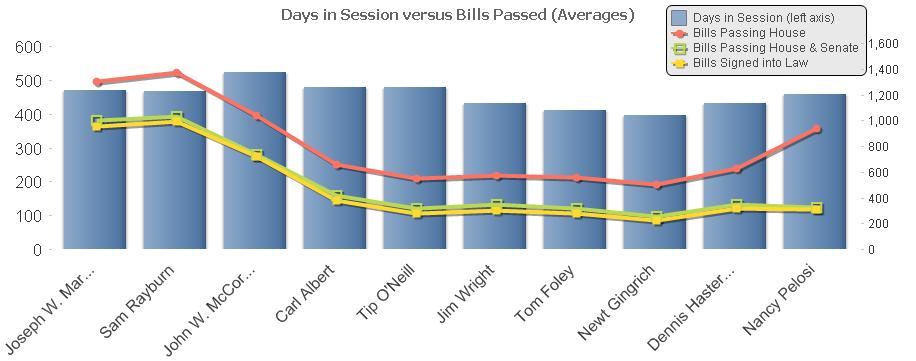
The chart above shows the Speakers since 1947 (the 80th Congress).  Bars show the average number of days in session took place under each.  The lines show the number of bills passing through Congress.  A couple of items become clear pretty quickly – the ratio of bills passing the House and then becoming law has been pretty consistent, except under current Speaker Nancy Pelosi.  For some reason the bills passing the House are not becoming law at the same clip as previously (this only accounts for 2007/2008 – no bills from the current Congress are included).

Another item to note is that the total days in Session has been fairly consistent around 470 per two year term.  Newt Gingrich had the lowest average at 397 days and John McCormack had the highest at 525 days.  I’m not sure that days in session is a good figure for understanding Speaker efficiency though since there may be many reasons that cause a higher or lower total.

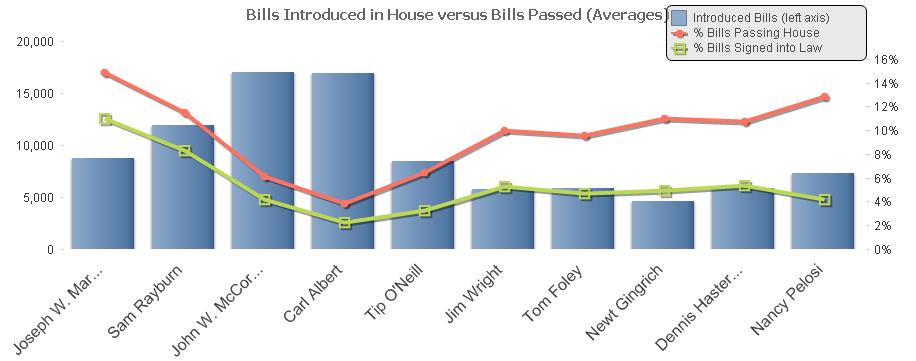
Changing up the chart though to look at total Bills Introduced against the percent of bills passing gives us a bit of a different story:

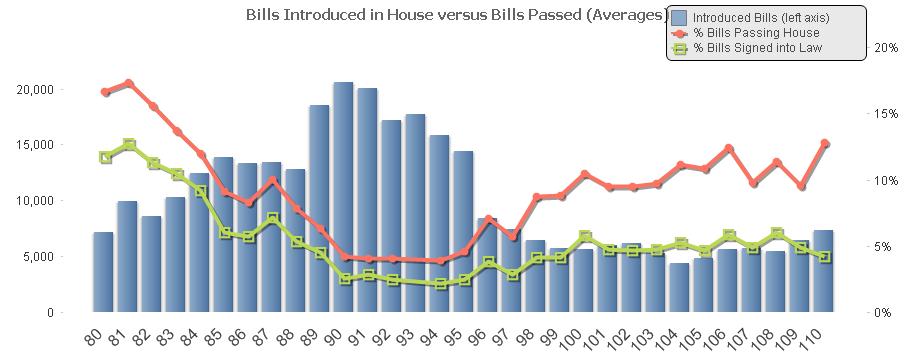
There was a spike in the number of bills introduced to the House under Speakers Rayburn, McCormack and Albert.  Sam Rayburn was able to get those bills pass and converted into laws at an impressive rate whereas Carl Albert was not.  Since then the trend has settled in to about 4% of all bills introduced to the House go on to become laws but Speakers seem to be working very hard to promote a high passage rate of bills being introduced.  Since Newt Gingrich, bills introduced have gone up, the rate of bills passing the House has gone up but the percent of bills becoming law has stayed flat.  The trend becomes even more clear when we look at it by Congress:

What does this all mean?  Apparently Speakers have a significant impact on the ability of the House of Representatives to effectively legislate, but there are a lot of factors that go into determining which Speakers did a good or poor job of it.  Over the next week we’ll continue to look at the numbers and get deeper into developing our rankings.

I’m particularly interested to see what impact Government control, world events and even political experience may or may not play in Speaker effectiveness.

Guten Tag, Herr President

In the patriotic summer of 1776, the United States of America was about to reach a crucial turning point. The colonies had declared their independence from Great Britain. War was coming. And in the heat of all these changes, a critical point of tension was about to be resolved: What should the new country’s official language be, English or German?

The debate was fierce. Delegates from western Pennsylvania and other heavily German populated regions argued valiantly that German people made up a significant portion of the population and that their language should replace English, the de facto official language. Opponents argued that more colonists spoke English, as did all the delegates at the Continental Congress. After each side made its case, the vote was held.

The “ayes” and “nays” were tallied, and the two sides were deadlocked, with one vote remaining to be heard. That vote belonged to ayoung Pennsylvania delegate: Frederick Muhlenberg, a minister of German ancestry. As Muhlenberg rose to speak, a palpable silence filled the chamber. He then cast the deciding vote…against making German the official language! And the way was paved for America’s allegiance in World Wars I & II.

Continental Congress

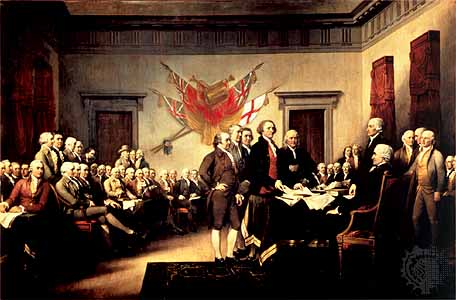
The Continental Congress Debates the Official Language Proposition

This is the so-called “Muhlenberg Legend” (with a little embellishment): that a German man stopped German from becoming the country’s official language. In fact, there was no such vote on this issue in 1776 or at any other time in the nation’s history, and to this day the United States does not recognize any official language. But this urban myth is widespread in the United States and, interestingly enough, Germany, despite the fact that it has been proven false repeatedly. Why is that? There are a couple big reasons, I would guess.

First, the legend does have a kernel of truth at its source. In 1794 a group of German-speaking Virginia farmers who did not know English petitioned Congress to have some laws translated into German, so that they may be able to read and understand them. The petition is recorded in the Journal of the House of Representatives of the United States for Thursday, January 9, 1794:

A petition of a number of Germans, residing in the State of Virginia, was presented to the House and read, stating the inconveniences to which they are subjected, from an entire ignorance of the English language, and praying that a certain proportion of the laws of the United States may be printed in the German language.

Ordered, That the said petition do lie on the table.

This entry appears several times in the Journal for the third Congress. At the time, Frederick Muhlenberg was serving his second term as Speaker of the House, an office which he was the first to hold. There was a vote taken on this specific issue on January 13, 1795 (although I found no record of it in the House Journal). And the final count was indeed 42-41 against translating the laws. Muhlenberg, however, reportedly abstained from the vote, and also reportedly said later: “The faster the Germans become Americans, the better it will be.”

It’s fairly easy to see how these facts could morph into the Muhlenberg Legend we all know and love today, especially combined with the second possible reason for the strength of the myth: drama. It just sounds so cool that the United States’ official language came down to a single vote, cast by a German man against his own heritage. Add in the 1776 factor, and it’s just too perfect to ignore. As young as this country is, and as great a record as we have of the early days of the United States, I think Americans love their country’s mythology at least as much as any other people. And when, as an American, you hear a story like this, you can’t help but want it to be true. And then there’s the whole historical fiction aspect. What if it hadn’t been for that one vote? Would we all be speaking German today? Would we have sided with Germany in World War I, crushing the hated English, our former colonial masters? Would there be some warped dialect of German with all the ßs taken out of words? What does a German southern or Boston accent sound like? The American mind is in awe at the possibilities.

Further Reading

For a more thorough treatment of the Muhlenberg Legend and related issues, see Dennis Barron’s essay. It was the main source for this post, along with help from the House Journal archives at the Library of Congress and Wikipedia.

Until next time, auf wiedersehen!

Value of Research

Research is the driver behind learning about any new topic.  When you don’t know anything, you have to go out and find the information on your own.  It’s an adventure you take to discover something new.

It’s a powerful process once you get into it for something that you choose to do it for.  Everyone researches for their job or for school, but it seems rare that people sit down on a regular basis and teach themselves something brand new and completely outside of anything they ever thought to learn about.

We’ve been in the process of researching the House of Representatives (specifically Speakers of the House) and it seems that we’re constantly in a state of amazement.  Learning about the issues the first congresses had to face, historical impacts on elections, trends in the number of bills submitted, that Sam Rayburn ruled the House of Representatives for 20 years (under FDR, Truman, Eisenhower AND Kennedy).

Sometimes the details of life can begin to drag things down.  Go out and learn about something new and suddenly whole new avenues of what’s possible in life open up to you.  Just pick a topic and spend an hour a day for three weeks on it.  You’ll be surprised about how much you learn (and most of it won’t be what you expect).

Speakers – A Brief Overview

The Speaker of the House is second in line for the Presidency but often seems to be overlooked by the general public.  Speakers are selected every 2 years by the majority party in the House of Representatives.  Generally, their role is administrative and their power is derived from their ability to control the flow of bills through the chamber – moving bills they support through and suffocating those that they don’t.  Some have been very successful while others merely fulfill the administrative requirements.

At the beginning of every new Congress a Speaker is elected by the House of Representatives.  There have been 52 Speakers in US history with an average tenure of just over two sessions (although more recently the average tenure has approached three terms).

Eight Speakers have served 8 years or longer:

  • Henry Clay (1811 – DR – Kentucky) – 6 terms
  • Andrew Stevenson (1827 – D – Virginia) – 4 terms
  • Joseph Gurney Cannon (1903 – R – Illinois) – 4 terms
  • Champ Clark (1911 – D – Missouri) – 4 terms
  • Sam Rayburn (1940 – D – Texas) – 10 terms
  • John McCormack (1962 – D – Massachusetts) – 5 terms
  • Tip O’Neil (1977 – D – Massachusetts) – 5 terms
  • Dennis Hastert (1999 – R – Illinois) – 4 terms

Henry Clay is generally credited as the person who made the position of Speaker powerful.  He used the position to promote his and (to a lesser degree) his party’s agendas.  Since him, the position has had some high moments although James Polk is the only Speaker who has eventually gone on to become President.

A lot more great history, looking forward to getting deeper into it.

MQ1: Metrics

Frederick Muhlenberg, first Speaker of the House

Frederick Muhlenberg, first Speaker of the House of Representatives

We’re proposing to measure and rank the relative influence of each Speaker of the U.S. House of Representatives, to develop so-called “Power Rankings” for this critical position near the top of the United States government’s power structure. As I started collecting data, I hit one of the key questions that we need to answer if we’re to come up with any sort of credible measurement: How do we define the influence of the Speaker of the House? Clearly, such influence must be defined in terms of outcomes the Speaker has an effect on, both direct and indirect. A quick list I came up with:

  • Bills passing the House: Assuming that the Speaker supports all of the majority party’s causes, calculating the ratio of passed bills to proposed bills would help us infer how much control the Speaker has over her own party, which is probably the primary measure of a House Speaker’s power
  • Bills passing the House and Senate: This ratio could give us a hint as to whether the Speaker’s power transfers over to the other side of the Capitol. If the House is passing bills, but the Senate rejects them, then the Speaker of the House probably doesn’t have much influence over Congress as a whole, especially if the Senate has the same majority party as the House.
  • Bills signed into law by an opposing President: Again, this shows the extent of the Speaker’s power, by seeing how far he can get a bill through the lawmaking process. If a President of a different party signs into law a bill proposed by the House majority party, then either: (a) it’s a good but probably unpopular law; (b) the President is afraid of the public backlash if he vetoes the law; or (c) the President knows the veto will be overridden. In the first case, the Speaker is able to convince his party members that, despite the political cost, the law must be passed. In the latter two cases, the Speaker is able to muster enough support from Congress and the public to influence the President’s actions.
  • Vetoes overridden: See (c) above. Basically, if 2/3 of the House can be convinced to override a veto, then the Speaker of the House must have control over her party’s representatives.
  • Causes personally supported by SotH proposed as bills: This measures the speaker’s influence beyond the party’s mainstream platform.

I think these variables are a good start, even if they are imperfect (e.g., the Majority Leader may share much of the responsibility for whipping the majority party into shape, and I don’t how much they take orders from the House Speaker). They are quantitative rather than qualitative; the data is fairly easy to find; they can be measured in total instead of having to examine the Speaker’s influence on each bill individually; and they fit the common view we have of how the Speaker of the House’s power is manifested — i.e., the bills that are actually passed and make it to the President’s desk.

One thing we’ll have to look for when deciding if these are appropriate variables or not is whether there is any variance within them; otherwise, they won’t really tell us anything. And there are other, less easy to find ways to measure such influence: backroom deals, quid pro quos, and all that other political insider stuff that doesn’t quite make it to Wikipedia’s page on bills passed in the 110th Congress.

Over the next few days, we’ll be thinking about the meaning of influence in this context, how we want to measure it, and how far we’re willing to go with the research in this short amount of time. In fact, I think this will be a recurring theme of this blog: How do we decide upon and measure the variables that we think will help us answer our question?

MQ1 – Speaker of the House Power Rankings

Our inaugural question here at Motivating Questions!  (Don’t worry, the main focus won’t typically be on politics).

With the focus these days on political effectiveness it’s important to put things in perspective at times.  The charge of Congressional ineffectiveness has been leveled just about every year since the very first Congress.  With some big bills passed recently it may not be the case that this Congress is actually worse at getting things done.

We have 3 writers on-board at the moment and over the next three weeks we’re all going to be chipping in to provide some background on Congressional leaders over time and working to develop a model of their effectiveness.  At the end of this cycle we’ll all post our conclusions on which Speakers have yielded the most power.  Then we’ll come together to highlight any of our common conclusions or points of disagreement.

The goal is to learn.  At the very least, this will be an interesting journey.

Motivating Questions (a working title)

Welcome to the first post of Motivating Questions.  Our goal here is to approach interesting, complicated, topical and/or historical questions.  We hope that our research, thoughts and analysis over time will add some value somewhere but our only real goal is to continue the learning process (specifically our own).

Our approach is going to be fairly straightforward and hopefully easy for readers to follow.  Every 3 weeks (give or take depending on question complexity) we’ll ask a new question, provide the history and importance of the question, research deeper and then hopefully provide some conclusions.

Enjoy!