Michel gave his thoughts earlier on developing rankings of some ways we may use to evaluate which Speakers wielded the most power. For me, it’s not just about having and using power, it’s just as important to use the power effectively. Speakers that merely attempt to control the actions of the other Representatives in the House may actually end up being worse than Speakers that do nothing toward using their power.
My main focus will be on Speaker efficiency. There isn’t an easy measure for what efficiency is though – it’s actually a fairly vague notion in general. But what it allows is a framework to look at the overall performance of the Congresses they controlled. An efficient Speaker would likely be one that allows through an average to low number of bills for vote but passes a high percentage – focusing the chamber’s attention on matters that are both important and agreeable.
Beyond the ability to control their own chamber, they must be able to get their bills through to eventually becoming laws. There are three types of governments in the US – those where a single party controls the Presidency, Senate and House (Full Control); those where one party controls the Presidency and the other controls the Senate and House (Congressional Control); and then finally one where the Senate and House are controlled by separate parties (Split Control). Theoretically, the easiest environment to pass bills within should be one with Full Control while the most difficult would be the Split Control. This is a factor that will need to be controlled for when calculating efficiency.
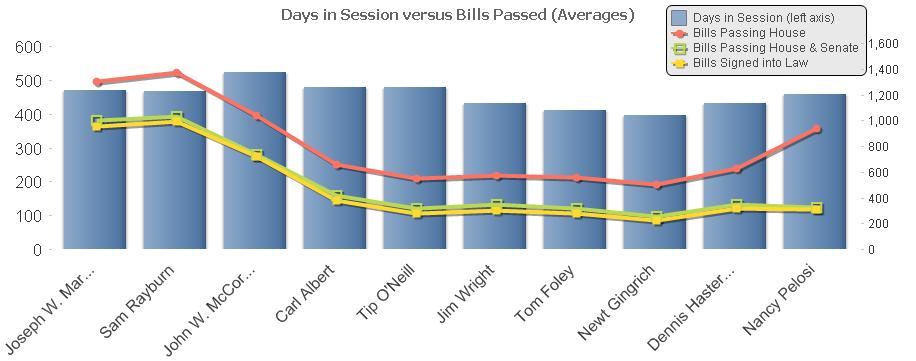
The chart above shows the Speakers since 1947 (the 80th Congress). Bars show the average number of days in session took place under each. The lines show the number of bills passing through Congress. A couple of items become clear pretty quickly – the ratio of bills passing the House and then becoming law has been pretty consistent, except under current Speaker Nancy Pelosi. For some reason the bills passing the House are not becoming law at the same clip as previously (this only accounts for 2007/2008 – no bills from the current Congress are included).
Another item to note is that the total days in Session has been fairly consistent around 470 per two year term. Newt Gingrich had the lowest average at 397 days and John McCormack had the highest at 525 days. I’m not sure that days in session is a good figure for understanding Speaker efficiency though since there may be many reasons that cause a higher or lower total.
Changing up the chart though to look at total Bills Introduced against the percent of bills passing gives us a bit of a different story:
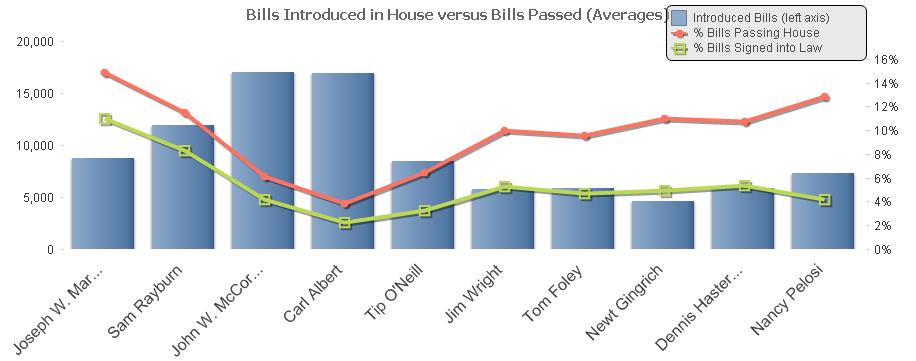
There was a spike in the number of bills introduced to the House under Speakers Rayburn, McCormack and Albert. Sam Rayburn was able to get those bills pass and converted into laws at an impressive rate whereas Carl Albert was not. Since then the trend has settled in to about 4% of all bills introduced to the House go on to become laws but Speakers seem to be working very hard to promote a high passage rate of bills being introduced. Since Newt Gingrich, bills introduced have gone up, the rate of bills passing the House has gone up but the percent of bills becoming law has stayed flat. The trend becomes even more clear when we look at it by Congress:
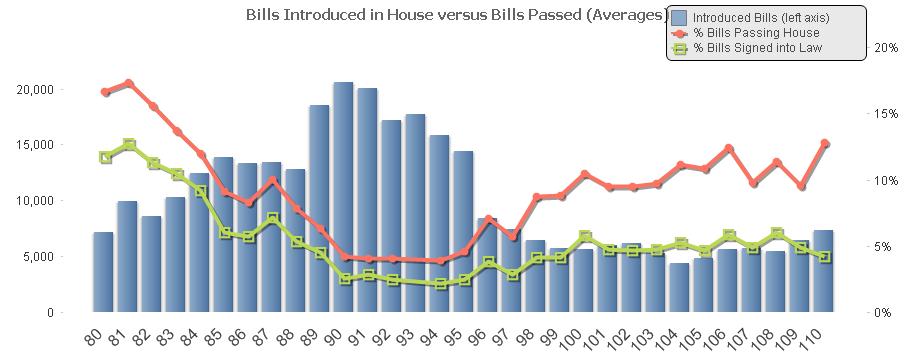 What does this all mean? Apparently Speakers have a significant impact on the ability of the House of Representatives to effectively legislate, but there are a lot of factors that go into determining which Speakers did a good or poor job of it. Over the next week we’ll continue to look at the numbers and get deeper into developing our rankings.
I’m particularly interested to see what impact Government control, world events and even political experience may or may not play in Speaker effectiveness.
0 Comments.