In the patriotic summer of 1776, the United States of America was about to reach a crucial turning point. The colonies had declared their independence from Great Britain. War was coming. And in the heat of all these changes, a critical point of tension was about to be resolved: What should the new country’s official language be, English or German?
The debate was fierce. Delegates from western Pennsylvania and other heavily German populated regions argued valiantly that German people made up a significant portion of the population and that their language should replace English, the de facto official language. Opponents argued that more colonists spoke English, as did all the delegates at the Continental Congress. After each side made its case, the vote was held.
The “ayes” and “nays” were tallied, and the two sides were deadlocked, with one vote remaining to be heard. That vote belonged to ayoung Pennsylvania delegate: Frederick Muhlenberg, a minister of German ancestry. As Muhlenberg rose to speak, a palpable silence filled the chamber. He then cast the deciding vote…against making German the official language! And the way was paved for America’s allegiance in World Wars I & II.
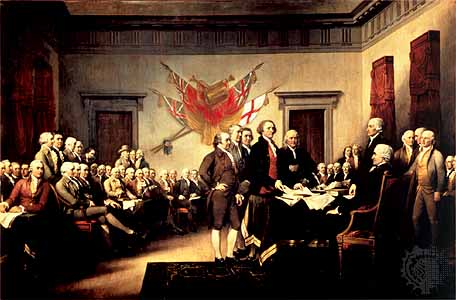
The Continental Congress Debates the Official Language Proposition
This is the so-called “Muhlenberg Legend” (with a little embellishment): that a German man stopped German from becoming the country’s official language. In fact, there was no such vote on this issue in 1776 or at any other time in the nation’s history, and to this day the United States does not recognize any official language. But this urban myth is widespread in the United States and, interestingly enough, Germany, despite the fact that it has been proven false repeatedly. Why is that? There are a couple big reasons, I would guess.
First, the legend does have a kernel of truth at its source. In 1794 a group of German-speaking Virginia farmers who did not know English petitioned Congress to have some laws translated into German, so that they may be able to read and understand them. The petition is recorded in the Journal of the House of Representatives of the United States for Thursday, January 9, 1794:
A petition of a number of Germans, residing in the State of Virginia, was presented to the House and read, stating the inconveniences to which they are subjected, from an entire ignorance of the English language, and praying that a certain proportion of the laws of the United States may be printed in the German language.
Ordered, That the said petition do lie on the table.
This entry appears several times in the Journal for the third Congress. At the time, Frederick Muhlenberg was serving his second term as Speaker of the House, an office which he was the first to hold. There was a vote taken on this specific issue on January 13, 1795 (although I found no record of it in the House Journal). And the final count was indeed 42-41 against translating the laws. Muhlenberg, however, reportedly abstained from the vote, and also reportedly said later: “The faster the Germans become Americans, the better it will be.”
It’s fairly easy to see how these facts could morph into the Muhlenberg Legend we all know and love today, especially combined with the second possible reason for the strength of the myth: drama. It just sounds so cool that the United States’ official language came down to a single vote, cast by a German man against his own heritage. Add in the 1776 factor, and it’s just too perfect to ignore. As young as this country is, and as great a record as we have of the early days of the United States, I think Americans love their country’s mythology at least as much as any other people. And when, as an American, you hear a story like this, you can’t help but want it to be true. And then there’s the whole historical fiction aspect. What if it hadn’t been for that one vote? Would we all be speaking German today? Would we have sided with Germany in World War I, crushing the hated English, our former colonial masters? Would there be some warped dialect of German with all the ßs taken out of words? What does a German southern or Boston accent sound like? The American mind is in awe at the possibilities.
Further Reading
For a more thorough treatment of the Muhlenberg Legend and related issues, see Dennis Barron’s essay. It was the main source for this post, along with help from the House Journal archives at the Library of Congress and Wikipedia.
Until next time, auf wiedersehen!
0 Comments.